Free until 31 December 2026YourVisaSite's released features are free until then. No card needed.
Official sources
Visa news
Changes to Australian visas checked against the government source, plus independent reporting, videos and our own posts. The official page is always the final word.
Posts and short videos we have published, newest first. Each links to the official source it relies on; the official page remains the authority.
Published by YourVisaSite
How to read a visa refusal notice
Short video with no sound; all information is shown as on-screen text. Visa basics. Read a refusal notice one reason at a time. Read each reason in the notice separately. Check the notice for review details and time limits. Compare each reason with the official requirements.
A visa refusal notice is a difficult document to receive, for an applicant or for a sponsoring employer. It is also the primary record of the decision, and it rewards a slow read.
Read the full post
Some general points:
- Take each reason on its own
- Look in the notice for whether a review is available and any time limit that applies
- Compare each reason with the current requirements on the official Home Affairs page for that visa
A new application is not automatically successful. Individual cases are a matter for a registered migration agent or an Australian lawyer. The official register of migration agents is maintained by the Office of the Migration Agents Registration Authority.
YourVisaSite does not assess individual cases. Each visa page links to its official Home Affairs source: https://yourvisasite.com/visas
General information only. Independent service; not affiliated with the Department of Home Affairs or the Australian Government.
Published by YourVisaSite. Official information from the Department of Home Affairs. General information only, not migration advice. The official page remains the authority.
Published by YourVisaSite
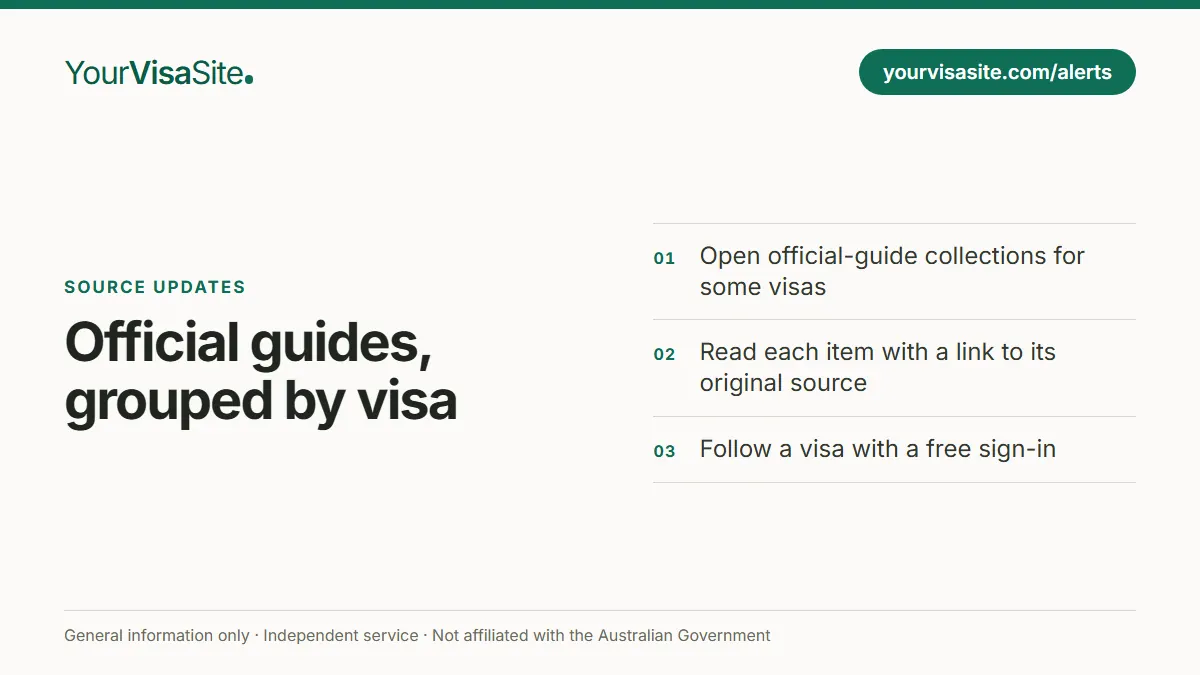
Source updates: official guides and feeds by visa
Image from the YourVisaSite post.
Second-hand visa summaries are difficult to rely on when the reader cannot see the source behind them.
Read the full post
The Source updates page on YourVisaSite is organised around that point. It gathers collections of official guides for some visas, currently the Skilled Independent (189), Student (500) and Partner (820/801) visas. Each item links to its original government page.
The page is plain about what it is. Collections are labelled as guides and are not announcements of visa-rule changes. RSS feeds are available for the same visas, and following a visa needs a free sign-in.
It is a way to reach official material faster. It does not replace the Department of Home Affairs website, which remains the place to confirm current information.
https://yourvisasite.com/alerts
General information only. Independent service; not affiliated with the Department of Home Affairs or the Australian Government.
Published by YourVisaSite. Official information from the Department of Home Affairs. General information only, not migration advice. The official page remains the authority.
Published by YourVisaSite
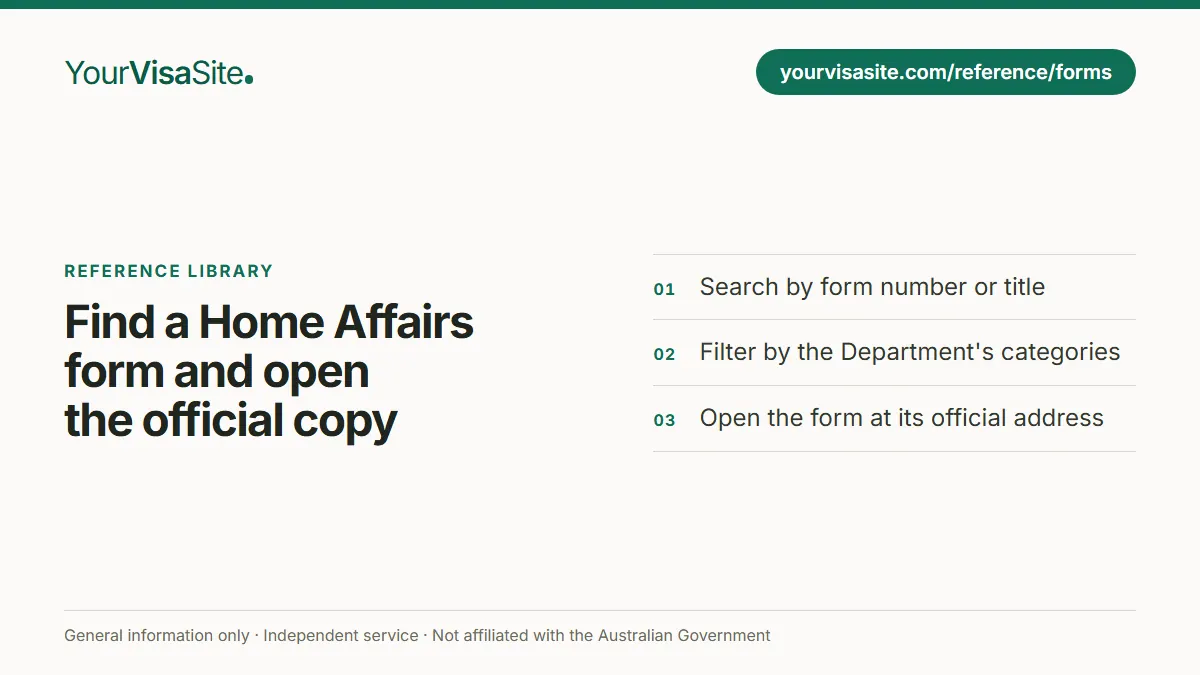
Forms reference: find the official Home Affairs form
Image from the YourVisaSite post.
A search for a departmental form often starts with only a form number or part of a title.
Read the full post
The YourVisaSite forms reference lists more than 100 official Home Affairs forms. It can be searched by form number or title and filtered by the Department's categories. Each entry opens the form at the Department's own address. Form detail pages set out the purpose of the form, who lodges it, the information it generally collects and the visas that commonly use it.
Two limits apply. Nothing is filled in or submitted on the site, and the page does not choose a form for anyone. Forms are updated and withdrawn, so the current version should always be confirmed in the official Home Affairs forms directory.
https://yourvisasite.com/reference/forms
General information only. Independent service; not affiliated with the Department of Home Affairs or the Australian Government.
Published by YourVisaSite. Official information from the Department of Home Affairs. General information only, not migration advice. The official page remains the authority.
Published by YourVisaSite
SkillSelect invitation rounds: past results on one page
Short video with no sound; all information is shown as on-screen text. Reference library. Past SkillSelect invitation rounds on one page. Round dates and program years. Invitations issued and lowest points score invited. Scores by occupation, where published.
The Department of Home Affairs publishes the results of each SkillSelect invitation round. For anyone who follows the skilled program, those results are the primary record.
Read the full post
The YourVisaSite SkillSelect rounds page sets out past results on one page for the Skilled Independent visa (subclass 189) and the family-sponsored Skilled Work Regional visa (subclass 491). Each round shows the date, the program year, the invitations issued, the tie-break date and the lowest points score invited. Scores by occupation are included where the Department published them.
The limits matter. A past result is a historical record and says nothing about a future round or any individual. The page is a dated copy, it does not assess points for anyone, and it links to the Home Affairs invitation rounds page, where the current record should be confirmed.
Published by YourVisaSite. Official information from the Department of Home Affairs. General information only, not migration advice. The official page remains the authority.
Published by YourVisaSite
Regional postcodes: check the official instrument
Image from the YourVisaSite post.
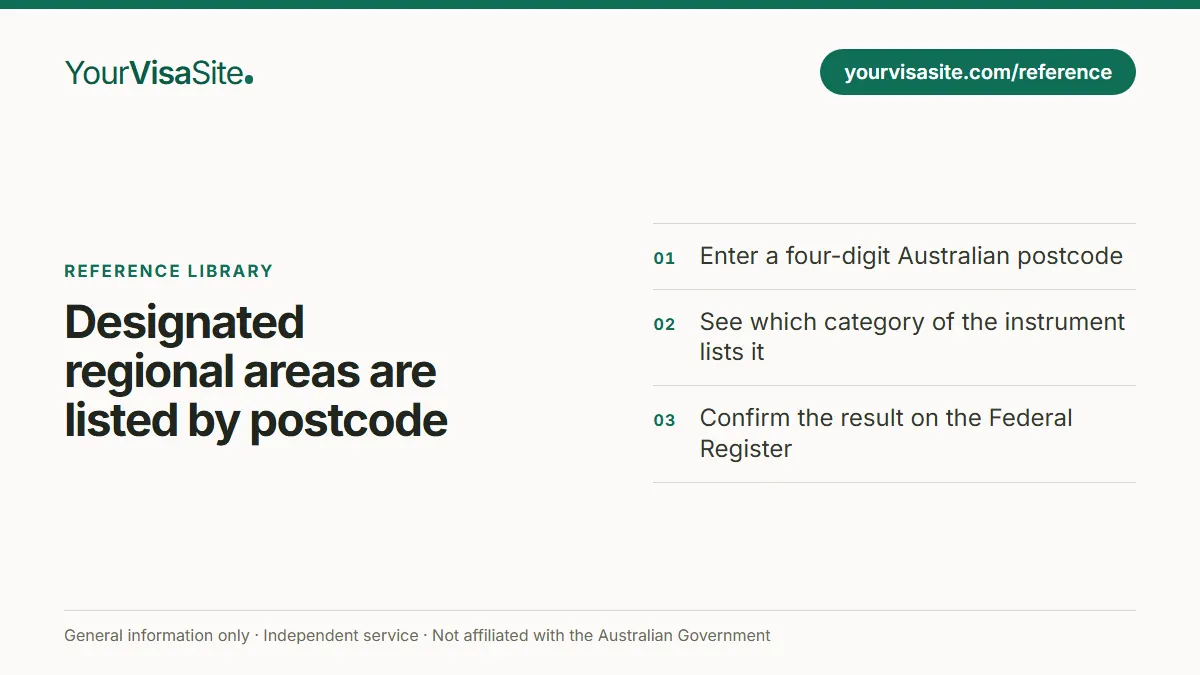
Whether a location counts as a designated regional area is set by legislation, not by general usage. For certain skilled and temporary graduate visas, the areas are listed by postcode in a legislative instrument, LIN 22/022, published on the Federal Register of Legislation (F2022L00231).
Read the full post
The YourVisaSite regional postcodes page is a lookup against a dated copy of that instrument. Enter a four-digit postcode and it shows whether the postcode falls inside a listed range, and under which of the two categories. The full ranges are set out by state and territory.
Two limits apply. The page is a range check, not a determination for any application. And each visa's own rules say which regional definition it uses, so the instrument itself, including any amendments, remains the place to confirm.
Published by YourVisaSite. Official information from the Federal Register of Legislation. General information only, not migration advice. The official page remains the authority.
Published by YourVisaSite
Visa Rooms: discussion rooms by visa
Image from the YourVisaSite post.
How the public discussion rooms on YourVisaSite are set up, and what they are not.
Read the full post
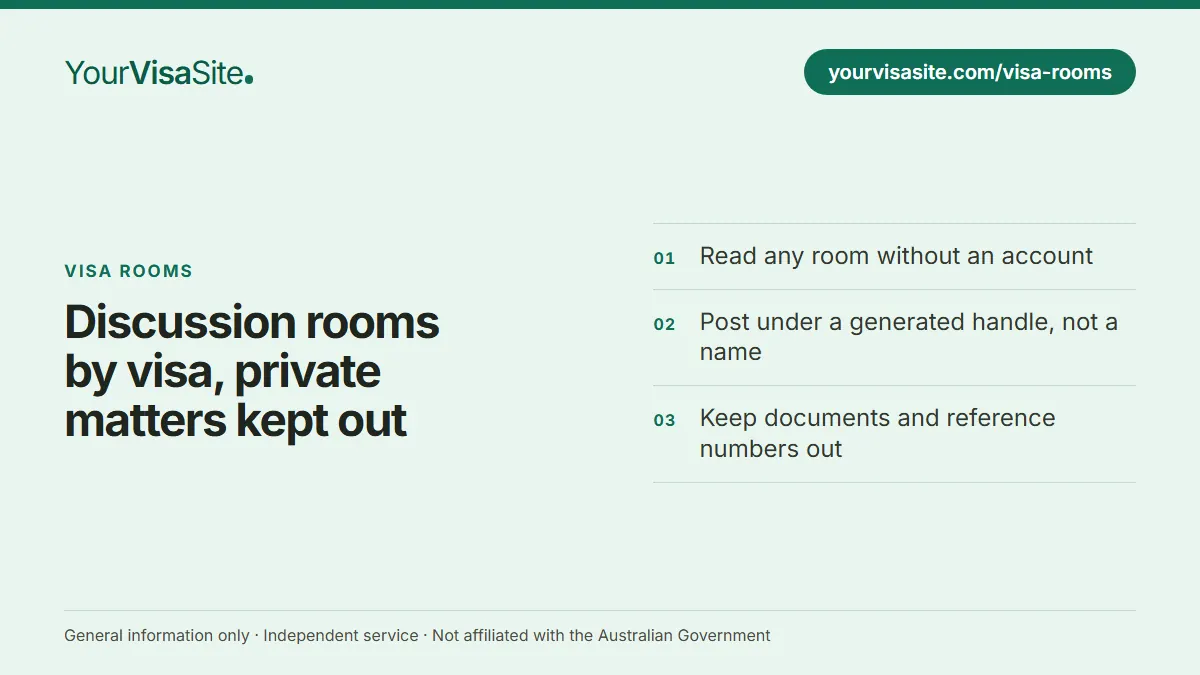
Visa Rooms are organised by visa, with 15 rooms open. Anyone can read a room without an account. Posting needs a sign-in, and members post under a generated handle. Account details are never shown.
Much of the current content is starter questions written by YourVisaSite. These are marked as editorial, are separate from member experience, and have not been reviewed by a lawyer or registered migration agent.
One rule applies throughout: share dates, stages and general experience, and keep names, documents, reference numbers and contact details out. Each room links to the official Home Affairs source for its visa, where the current requirements are published.
Rooms: https://yourvisasite.com/visa-rooms
General information only. Independent service; not affiliated with the Department of Home Affairs or the Australian Government.
Published by YourVisaSite. Official information from the Department of Home Affairs. General information only, not migration advice. The official page remains the authority.
Published by YourVisaSite
Visa scam warning signs
Short video with no sound; all information is shown as on-screen text. Consumer awareness. Three warning signs of a visa scam. A promise of a visa or a faster decision. A request to pay outside official channels. An offer that arrives without being asked for.
For visa applicants, and for the employers and education providers they often ask for a second opinion: three warning signs of a visa scam.
Read the full post
1. A promise. Nobody can guarantee a visa outcome.
2. A payment request outside official channels. Check the official website before paying any government charge.
3. An unsolicited offer by email, message or social media.
Home Affairs lists "cracking down on rogue migration agents" among its announced migration policy changes. The Office of the Migration Agents Registration Authority keeps a public register of registered migration agents, which anyone can search.
YourVisaSite is an independent information service. It is not a migration agent and does not assess eligibility. Every visa page links to its official Home Affairs source.
Visa index: https://yourvisasite.com/visas
General information only. Independent service; not affiliated with the Department of Home Affairs or the Australian Government.
Published by YourVisaSite. Official information from the Office of the Migration Agents Registration Authority. General information only, not migration advice. The official page remains the authority.
Published by YourVisaSite
Skills assessment: find the assessing authority
Image from the YourVisaSite post.
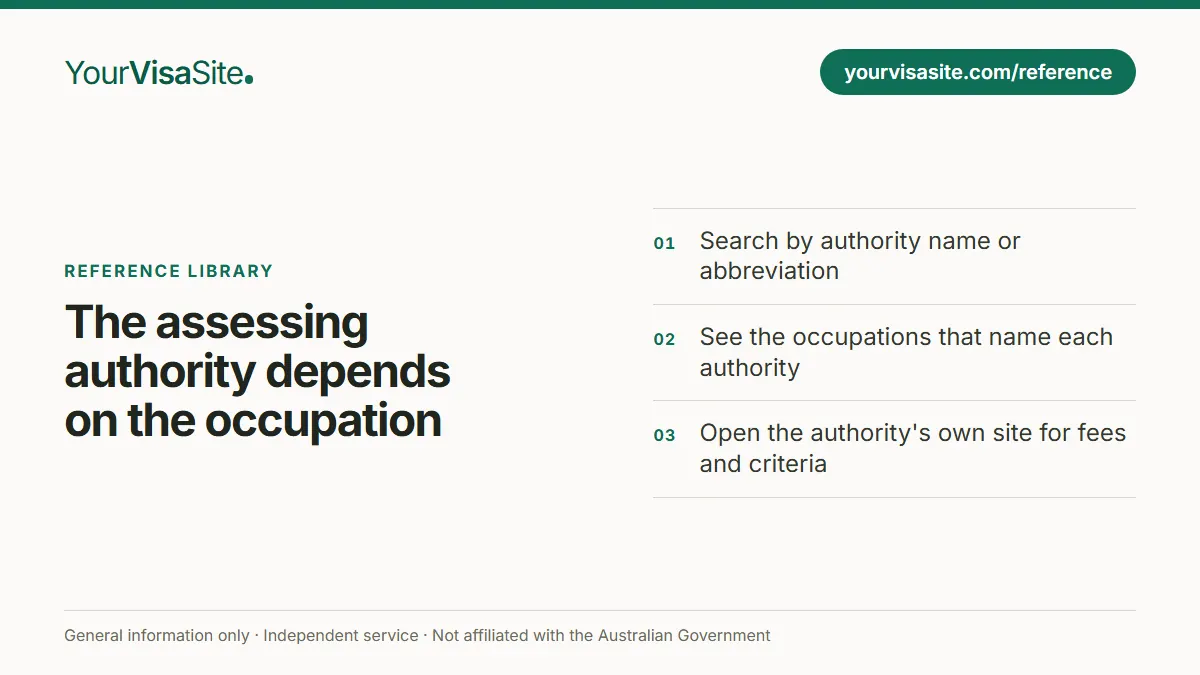
A skills assessment is tied to the nominated occupation, and so is the body that carries it out.
Read the full post
The skilled occupation instruments name the assessing authorities, occupation by occupation. Each authority publishes its own assessment criteria, fees and processing times, and can change them.
The YourVisaSite assessing authorities page is a public reference record. It lists the authorities named in the instruments, describes what each one assesses, and shows the occupations that name each authority with their ANZSCO codes and occupation lists.
It does not copy fees, criteria or processing times. Entries link to the authority's own website, and the Home Affairs skills assessment page remains the official starting point.
Published by YourVisaSite. Official information from the Department of Home Affairs. General information only, not migration advice. The official page remains the authority.
Published by YourVisaSite
Migration policy changes: the official Home Affairs list
Image from the YourVisaSite post.
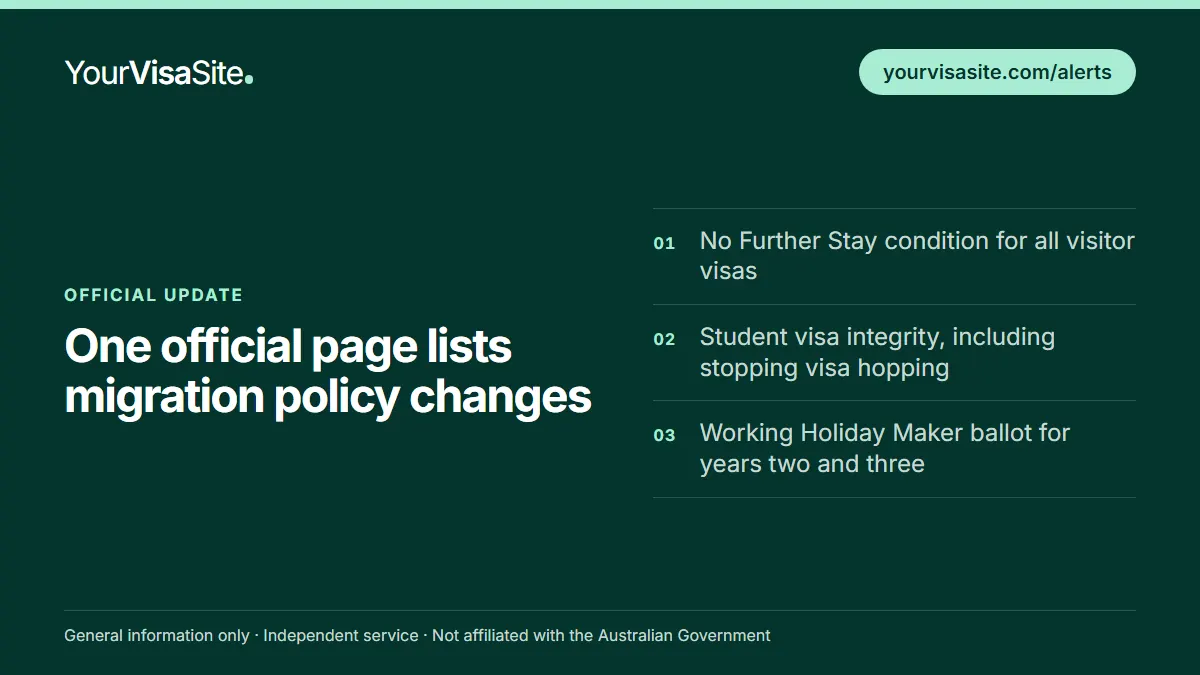
Home Affairs publishes one page listing the Australian Government's migration policy changes.
Read the full post
The page lists:
- a No Further Stay condition for all visitor visas
- updated skilled visa processing priorities
- student visa integrity measures, including stopping visa hopping
- strengthening compliance and cracking down on rogue migration agents
- an update to Ministerial Direction 110
- a Working Holiday Maker ballot for years two and three, with a regional work requirement
Home Affairs says the changes have begun to be implemented and will be progressively rolled out over the next 12 months. The page gives no start date for the visitor visa condition.
The updated skilled priorities took effect on 19 September 2026 under Ministerial Directions 121 and 122.
For how each item applies, read the Home Affairs page. Our Source updates page links to original sources: https://yourvisasite.com/alerts
General information only. Independent service; not affiliated with the Department of Home Affairs or the Australian Government.
Published by YourVisaSite. Official information from the Department of Home Affairs. General information only, not migration advice. The official page remains the authority.
Published by YourVisaSite
Occupation lists: search by ANZSCO code or title
Short video with no sound; all information is shown as on-screen text. Reference library. Skilled occupation lists in one searchable place. Search by ANZSCO code, title or assessing authority. See which published lists include each occupation. Open the official Home Affairs list from any record.
Australia's skilled occupation lists are set out across several legislative instruments. For employers, HR teams and practitioners, checking one occupation can mean reading more than one of them.
Read the full post
The YourVisaSite occupation reference brings hundreds of occupations into one searchable place. Search by ANZSCO code, title or assessing authority, or filter by list.
Each record shows:
- the lists that include the occupation
- the visas each list is used for
- the instrument behind each list, linked to the Federal Register of Legislation
- the assessing authority the instruments name
A list entry describes the instrument. It is not an assessment of any person, and instruments can be amended. The official Home Affairs skilled occupation list remains the place to confirm.
Published by YourVisaSite. Official information from the Department of Home Affairs. General information only, not migration advice. The official page remains the authority.